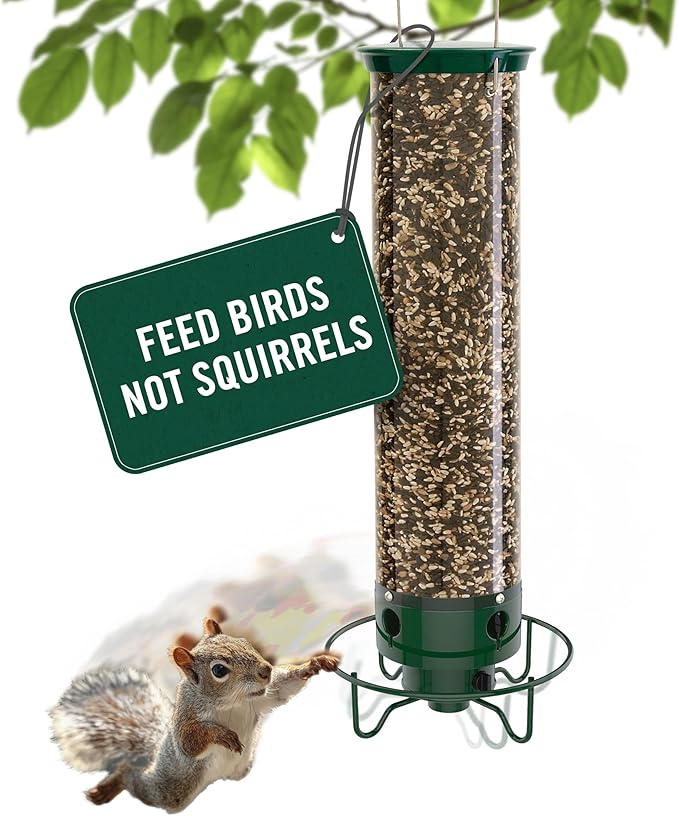
The feeder you choose matters. But where you hang it matters just as much. A Droll Yankees Yankee Flipper hung in the wrong location will attract fewer birds and more squirrels than a basic tube feeder in the right spot.
This guide covers the placement principles that consistently produce the best results: the most bird activity, the lowest squirrel success rate, and the safest conditions for the birds that visit.
The Three Core Placement Principles
1. Proximity to Cover
Birds need a sense of safety to feed confidently. Their instinct is to have an escape route nearby before committing to any exposed position — including a bird feeder.
The optimal placement distance from trees, shrubs, or dense vegetation is between 10 and 15 feet. Close enough that birds can retreat in a second if they sense a predator; far enough that cats or other ground predators cannot use the vegetation as a launching or hiding point.
In practice, this means positioning your Droll Yankees feeder at the edge of a garden border rather than in the middle of an open lawn. Open-lawn feeders typically attract fewer species and see less confident, shorter visits.
2. Window Strike Prevention
Window strikes kill approximately 600 million birds annually in North America. Feeders placed at the wrong distance from windows significantly increase strike risk. Position feeders either within 3 feet of or more than 10 feet from windows — the 3 to 10 foot range is the highest-risk zone.
- Within 3 feet of a window: Low risk. Birds leave the feeder too slowly to build lethal speed before reaching the glass.
- 3 to 10 feet from a window: Highest risk. Birds have enough space to reach significant speed before impact.
- More than 10 feet from a window: Low risk. Birds have enough visual information to identify the glass as a barrier and course-correct.
3. Height and Access
For hanging feeders: A height of 5 to 6 feet above ground level is generally optimal. High enough that ground predators cannot reach the feeder; low enough for comfortable maintenance.
For pole-mounted feeders: A dedicated feeder pole of 5 to 6 feet in height, with a squirrel baffle mounted 4 feet from the ground, provides the best combination of bird access, squirrel deterrence, and maintenance ease.
Related Posts:
- Droll Yankees Bird Feeders | Premium Feeders Built to Last
- How to Clean Droll Yankees Bird Feeders
- Droll Yankees Squirrel-Proof Bird Feeders
Squirrel-Specific Placement for Non-Motorized Feeders
If you are using the Yankee Whipper, Dipper, or Big Top rather than the motorized Yankee Flipper, feeder placement is your first line of squirrel defence. Squirrels can jump approximately 10 feet horizontally and 4 feet upward from a standing position. This means your feeder needs to be:
- At least 10 feet horizontally from any fence, wall, tree trunk, branch, or structure a squirrel can launch from.
- At least 4 feet above any surface a squirrel can reach from the ground.
- Below any tree branches by at least 6 feet vertically.
In many suburban gardens, achieving all three simultaneously requires a dedicated feeder pole placed in open ground rather than hanging from an existing tree.
Multiple Feeder Placement for Maximum Species Diversity
Using multiple Droll Yankees feeders in combination draws significantly more species than a single feeder, even a large one. An effective multi-feeder setup for a medium-sized suburban backyard:
- One squirrel-proof tube feeder (Flipper or Whipper) with black oil sunflower seed: For cardinals, chickadees, nuthatches, titmice.
- One Onyx Finch Magnet or Nyjer tube feeder: For goldfinches, purple finches, pine siskins.
- One ground tray or platform feeder: For juncos, towhees, sparrows, and doves.
- One water feature (birdbath): Dramatically increases overall garden bird activity across all species.
Space multiple feeders at least 6 feet apart to reduce competition and allow shy species to feed without being displaced by dominant ones.
Seasonal Placement Adjustments
Winter: Move feeders closer to cover. Cold-weather birds are more reluctant to make long exposed flights to a feeder.
Summer: Ensure feeders have some shade, particularly in the afternoon. Direct sun on a polycarbonate tube accelerates seed degradation. The Big Top dome feeder solves this automatically by shading the seed below it.
Migration periods (spring and autumn): Consider adding a second feeder temporarily, positioned in a slightly more open and visible location to attract passing migrants not familiar with your garden layout.