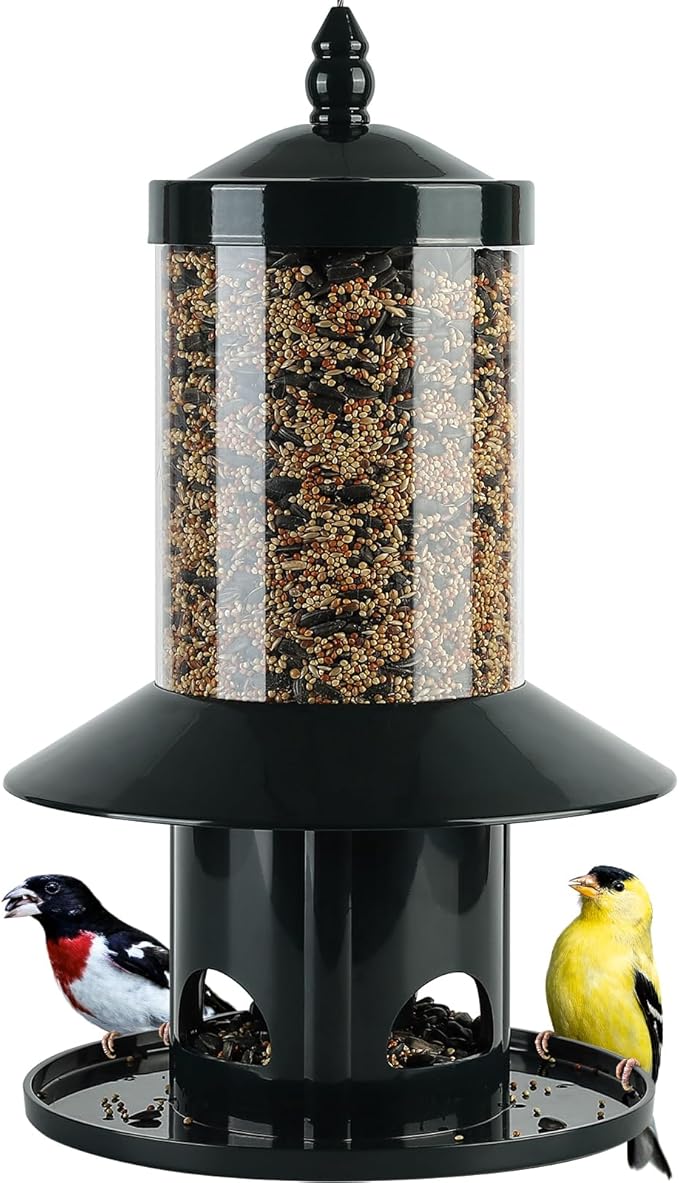
One of the most satisfying aspects of backyard bird feeding is learning which species visit your garden and understanding what draws each one there. Droll Yankees bird feeders attract a wide range of North American backyard species, from the vivid flashes of American Goldfinches to the bold, deliberate movements of Red-breasted Nuthatches.
This guide covers the most common species attracted to Droll Yankees feeders, with the specific feeder model and seed type most likely to draw each one.
American Goldfinch
The American Goldfinch is the species most closely associated with Droll Yankees’ nyjer feeder line. Brilliant yellow with black wings in summer plumage, goldfinches are active, social feeders that often arrive in flocks of 10 or more.
Best Droll Yankees feeder: Onyx Clever Clean Nyjer Feeder or Finch Magnet
Best seed: Nyjer (thistle) seed. Goldfinches have a strong preference for it and will often bypass other seed types to reach it.
Behavioural note: Goldfinches are clingers — they naturally feed while gripping vertical surfaces, which makes the mesh and tube port designs of the Droll Yankees nyjer range a perfect match for their feeding style.
Northern Cardinal
The Northern Cardinal is one of the most visually striking backyard birds in North America. The male’s all-red plumage with prominent crest makes it immediately recognisable. Cardinals are ground feeders by nature but adapt readily to tube feeders with larger ports and sturdy perches.
Best Droll Yankees feeder: Yankee Whipper or Ring Pull Classic Sunflower Feeder
Best seed: Black oil sunflower seed (their first choice) or safflower seed.
Behavioural note: Cardinals prefer feeders positioned near shrub cover. The Droll Yankees squirrel-proof models are calibrated to allow cardinal feeding while blocking squirrels.
Black-Capped Chickadee
Chickadees are the most reliably present and most universally loved backyard feeder bird in North America. Their acrobatic feeding behaviour — landing, grabbing a single seed, and retreating to a branch to eat before returning — gives gardens a constant sense of activity and energy.
Best Droll Yankees feeder: Any model in the range. Chickadees use tube, classic, and squirrel-proof feeders without preference.
Best seed: Black oil sunflower seed or sunflower hearts.
Behavioural note: Chickadees weigh approximately 0.4 ounces. They will never trigger a weight-sensitive mechanism on any Droll Yankees feeder, making all models suitable.
Related Posts:
White-Breasted Nuthatch
Nuthatches are immediately recognisable by their habit of descending tree trunks head-first — a posture no other common backyard bird uses. They are bold, efficient feeders that visit feeders repeatedly throughout the day, often caching seed for later retrieval.
Best Droll Yankees feeder: Onyx 18-Inch Tube Feeder or Ring Pull Classic
Best seed: Black oil sunflower seed or shelled peanuts (peanut chips).
Behavioural note: Nuthatches prefer to take one seed at a time and cache it, making them efficient users of a high-capacity feeder like the Onyx 18-Inch.
Purple Finch and House Finch
Both purple and house finches are common backyard visitors and close relatives of the American Goldfinch. They are social, vocal birds that arrive in flocks and often spend extended time at a feeder.
Best Droll Yankees feeder: Onyx Nyjer Feeder, Finch Magnet, or Finch Flocker Thistle Feeder
Best seed: Nyjer seed, sunflower hearts, and sunflower chips.
Behavioural note: House finches in particular can monopolise feeders due to their social, extended feeding behaviour. A larger capacity tube feeder accommodates flocks more effectively.
Blue Jay
Blue Jays are among the most intelligent birds that visit backyard feeders. They have excellent memories, are known to remember specific food caches for months, and use accurate mimicry of hawk calls to clear feeding stations of competitors.
Best Droll Yankees feeder: Onyx 18-Inch Mixed Seed Feeder or a separate platform feeder alongside your tube feeders
Best seed: Peanuts in the shell, mixed seed with sunflower, and cracked corn.
Behavioural note: Blue Jays are too large for most tube feeder ports and are better served by a supplementary platform or tray feeder alongside your primary Droll Yankees tube setup.
Pine Siskin
Pine Siskins are irruptive winter visitors — abundant in some years and nearly absent in others, depending on northern seed crop conditions. They are small, streaky brown birds with yellow wing patches.
Best Droll Yankees feeder: Finch Magnet Mesh Feeder or Finch Flocker Thistle Feeder
Best seed: Nyjer seed. Pine siskins and goldfinches often feed together on the same nyjer feeders.
Behavioural note: In irruption years, a single Droll Yankees nyjer feeder can attract flocks of 20 to 40 pine siskins simultaneously. The Finch Flocker’s multi-port design accommodates this far better than a single-port feeder.
Tufted Titmouse
The Tufted Titmouse is a year-round resident across much of eastern North America. Its grey plumage with rust-coloured flanks and prominent pointed crest make it easy to identify. It tends to visit feeders in pairs or small family groups.
Best Droll Yankees feeder: Any tube or squirrel-proof feeder in the range
Best seed: Sunflower seeds and shelled peanuts.
Behavioural note: Titmice, like chickadees, cache seed habitually. They are among the lighter feeder birds and will not trigger weight-sensitive mechanisms.